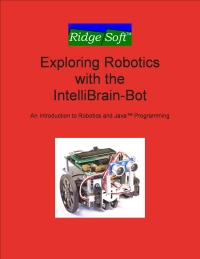
This book provides the curriculum for an introductory robotics course. The curriculum is suitable for students who have little or no prior Java programming experience, as well as students who have studied computer science. The IntelliBrain-Bot Deluxe educational robot is used as a hands on tool to introduce robotics and Java programming concepts.
| |
Chapter Description |
Resources |
 |
Chapter 1
Introducing the IntelliBrain-Bot
This chapter introduces the features of the IntelliBrain-Bot educational robot and provides a hands-on demonstration of many of its capabilities. |
IntelliBrain-Bot demo program
|
 |
Chapter 2
Programming the IntelliBrain-Bot
This chapter introduces students to creating programming projects, writing a simple program, compiling it, running it and debugging it.
|
Completed chapter 2 program |
 |
Chapter 3
Maneuvering the IntelliBrain-Bot
This chapter introduces concepts that will enable students to program the robot to perform maneuvers such as driving forward and back, turning and driving in a square. Additionally, students are introduced to using API documentation, as well as, loops, variables and conditional expressions.
|
Completed chapter 3 program
|
 |
Chapter 4
Interacting with the IntelliBrain-Bot
This chapter introduces students to programming the human interface features of the robot by programming it to perform a number of tricks, including dancing and playing a tune. This chapter also introduces if statements, arithmetic operations, logic operations and switch statements.
|
Completed chapter 4 program |
 |
Chapter 5
Introduction to Sensing
This chapter introduces students to sensing by experimenting with the Ping))) ultrasonic range sensor. In addition to illustrating how to control the sensor, how to measure the speed of sound and how to measure distance using the sensor, students are taught how to create a "tractor beam" effect using the sensor. This chapter also introduces floating point data types and the proportional control algorithm.
|
Completed chapter 5 programs |
 |
Chapter 6
Line Following
This chapter introduces students to using analog-to-digital conversion to sample photo reflective sensors. Students are taught how the sensors work, as well as two different algorithms for following a line: using a single sensor and proportional control and using two sensors and a finite state machine. This chapter also introduces using constants and arrays. |
Completed chapter 6 programs |